 Free Canada-Wide Shipping on Orders $300+
 Proudly Canadian
 Third-Party Lab Tested - 99% Purity Standards

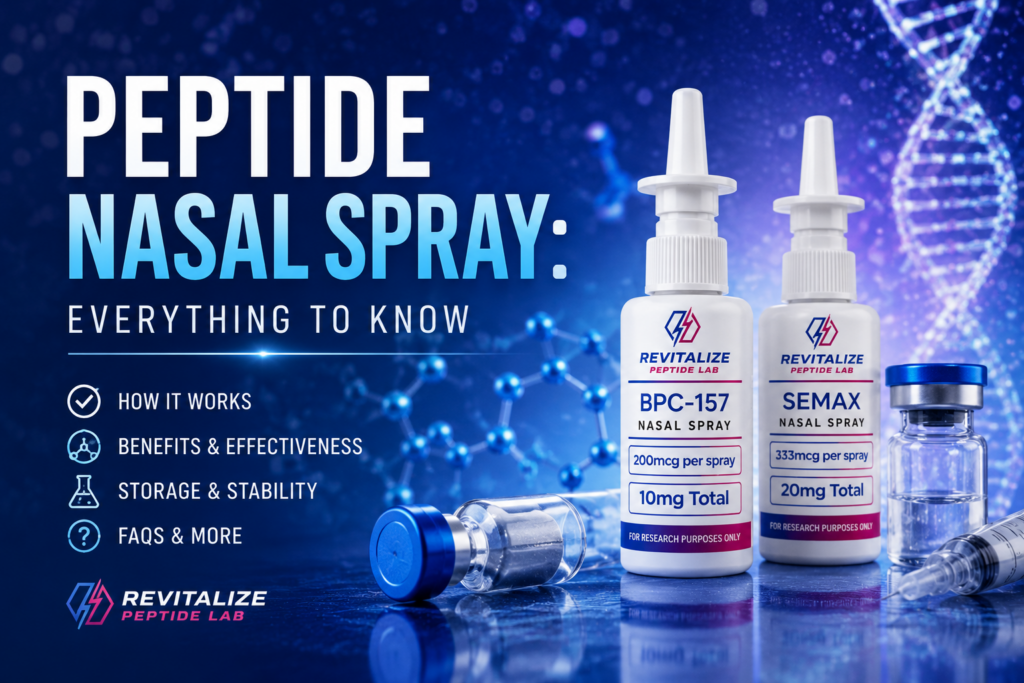
Peptide Nasal Sprays: How They Work, Why They’re Effective, and What Researchers Should Know
If you’ve ever wondered how peptide nasal sprays work, whether they are effective, or why researchers choose nasal delivery, you’re not alone. As peptide nasal sprays continue to grow in popularity, many researchers are looking for a convenient, needle-free method of administration that bypasses the digestive system.
In this guide, we’ll explain how peptide nasal sprays work, why they’re commonly used in laboratory research, how to store them properly, and answer some of the most frequently asked questions about intranasal peptide administration.
If you’re interested in exploring available formulations, browse our complete collection of peptide nasal sprays:
https://revitalizepeptidelab.is/product-category/nasal-sprays/
What Is a Peptide Nasal Spray?
A peptide nasal spray contains a research peptide dissolved in a sterile solution and delivered as a fine mist using a metered nasal spray bottle.
Instead of passing through the digestive system, the peptide is deposited onto the nasal lining, where it comes into contact with a thin, highly vascular membrane containing thousands of tiny blood vessels. This provides an alternative administration route that avoids exposure to stomach acid and digestive enzymes.
How Do Peptide Nasal Sprays Work?
The inside of the nose is lined with a moist membrane known as the nasal mucosa. This tissue has an extensive network of blood vessels and serves as one of the body’s natural absorption surfaces.
When a nasal spray is administered correctly:
- The fine mist coats the nasal mucosa.
- The peptide remains in contact with the nasal lining.
- Some peptide molecules may be absorbed through the nasal membrane.
- The remaining solution is gradually cleared through the body’s natural mucociliary system.
The amount absorbed depends on several factors, including:
- Peptide size
- Molecular structure
- Stability in solution
- Formulation
- Spray particle size
- Contact time with the nasal mucosa
Because every peptide has different chemical properties, absorption characteristics can vary between compounds.
Why Not Simply Swallow Peptides?
Many peptides are rapidly broken down by stomach acid and digestive enzymes before they can remain intact.
Intranasal administration bypasses the gastrointestinal tract, making it an attractive option for research involving peptides that are not well suited for oral administration.
Are Peptide Nasal Sprays Effective?
Intranasal administration has become an important area of peptide research because it provides an alternative route of administration that bypasses the digestive system. Many researchers consider nasal delivery to be an effective method for certain peptides due to the highly vascular nature of the nasal cavity and its potential to support peptide absorption.
However, effectiveness depends on several factors, including:
- The peptide being studied
- Formulation quality
- Peptide concentration
- Proper storage
- Correct administration technique
- Stability after reconstitution
Not every peptide performs equally well as a nasal spray, which is why careful formulation and handling remain important considerations in research.
Why Researchers Choose Peptide Nasal Sprays
Researchers often choose intranasal delivery because it combines convenience with a practical administration method for peptides that may not be suitable for oral research.
Potential advantages include:
- Needle-free administration
- Convenient and easy to use
- Bypasses digestive enzymes and stomach acid
- Simple and consistent dosing using metered spray pumps
- Portable and travel-friendly
- Quick and easy administration
- Commonly studied for peptides investigated in cognitive, regenerative, and metabolic research
Why Are Some Peptides Better Suited for Nasal Delivery?
Certain peptides have characteristics that make them particularly interesting for intranasal research.
Examples include:
- Semax
- Selank
- DSIP
- Oxytocin
- PT-141
- BPC-157
- Wolverine (BPC-157 + TB-500)
- KPV
- Melanotan II
These peptides have all been investigated in research involving intranasal administration, although the extent of available evidence varies depending on the individual peptide.
Factors That Can Affect Nasal Spray Performance
Several factors influence the quality, stability, and consistency of a peptide nasal spray.
Proper Storage
Peptide nasal sprays should be refrigerated both before and after reconstitution to help preserve peptide stability.
Before reconstitution, refrigeration (2–8°C / 36–46°F) helps protect the lyophilized peptide from unnecessary heat exposure. After the sterile solution has been added, continued refrigeration helps maintain solution quality and reduce degradation over time.
For best research practices:
- Store refrigerated at 2–8°C (36–46°F) before and after reconstitution.
- Protect from direct light.
- Avoid repeated warming and cooling whenever possible.
- Do not freeze unless specifically recommended for the individual peptide.
- Gently roll the bottle if mixing is required rather than shaking vigorously.
Proper storage helps support consistent peptide stability throughout the intended research period.
Correct Administration
Proper administration technique can help improve consistency during research.
Researchers commonly recommend:
- Gently clearing the nasal passages before use.
- Holding the bottle upright during administration.
- Spraying toward the outer wall of the nostril rather than directly toward the nasal septum.
- Avoiding forceful sniffing immediately after spraying.
- Allowing the solution a few moments to remain in contact with the nasal lining.
Solution Stability
Peptides are delicate molecules, and several factors may influence their stability after reconstitution.
These include:
- Temperature
- Light exposure
- Repeated warming and cooling
- Excessive shaking or agitation
- Buffer composition
- pH
- Storage duration after reconstitution
Maintaining stable storage conditions and handling the solution gently can help preserve peptide integrity throughout the intended research period.
Can Peptide Nasal Sprays Be Absorbed Quickly?
One reason researchers are interested in nasal sprays is the unique structure of the nasal cavity.
The inside of the nose contains a thin, highly vascular lining with a rich network of blood vessels. Because of this, certain peptides being studied may be absorbed through the nasal lining without first passing through the digestive system.
Researchers continue to study how different peptides behave when administered intranasally, as absorption can vary depending on the peptide’s size, structure, and formulation. Not every peptide is equally suited for nasal delivery, which is why formulation and stability remain important considerations.
Choosing a High-Quality Peptide Nasal Spray
When selecting a peptide nasal spray for laboratory research, consider the following factors:
- High peptide purity
- Accurate peptide concentration
- Sterile preparation
- Stable formulation
- Clear storage recommendations
- Reliable metered spray bottle
- Easy-to-follow preparation and handling instructions
Quality manufacturing and proper storage can help provide greater consistency throughout the research process.
Frequently Asked Questions
How many sprays are typically in a bottle?
The exact number depends on the bottle size and spray pump used. Many metered nasal spray bottles provide approximately 50–60 sprays per bottle.
Should peptide nasal sprays be refrigerated?
Yes. Peptide nasal sprays should be refrigerated before and after reconstitution. Refrigeration helps preserve peptide stability and supports solution quality throughout storage.
How long do peptide nasal sprays last after reconstitution?
When stored properly in the refrigerator (2–8°C / 36–46°F), peptide nasal sprays are generally intended to be used within 30 days after reconstitution.
To help maintain peptide stability and solution quality:
- Store refrigerated before and after reconstitution.
- Protect from direct light.
- Avoid repeated warming and cooling whenever possible.
- Discard any remaining solution after 30 days, even if some product remains in the bottle.
Following these storage recommendations helps support consistent peptide stability throughout the intended research period.
Can peptide nasal sprays replace injectable peptides?
Not necessarily. Different administration routes may result in different absorption characteristics, and not every peptide is equally suited for intranasal delivery. The most appropriate administration method depends on the peptide being studied and the objectives of the research.
Which Peptides Are Available as Nasal Sprays?
Revitalize Peptide Lab currently offers a growing selection of peptide nasal sprays designed for laboratory research, including:
- AOD-9604
- BPC-157
- Wolverine (BPC-157 + TB-500)
- DSIP
- KPV
- Melanotan II
- Oxytocin
- PT-141
- Selank
- Semax
Each formulation is prepared using high-purity research peptides and is designed for convenient intranasal administration in laboratory settings. Product specifications, storage recommendations, and preparation instructions are provided on each product page.
Browse our complete collection of peptide nasal sprays:
https://revitalizepeptidelab.is/product-category/nasal-sprays/
Final Thoughts
Peptide nasal sprays have become an increasingly popular administration method in laboratory research because they offer a convenient, needle-free alternative to other delivery methods while avoiding the digestive tract. Although not every peptide is equally suited for intranasal administration, many compounds continue to be investigated using this route because of its unique absorption characteristics and ease of use.
As with any research peptide, proper formulation, sterile preparation, refrigerated storage before and after reconstitution, and careful handling all play important roles in maintaining peptide stability and supporting consistent research outcomes.